By Holly Hastings
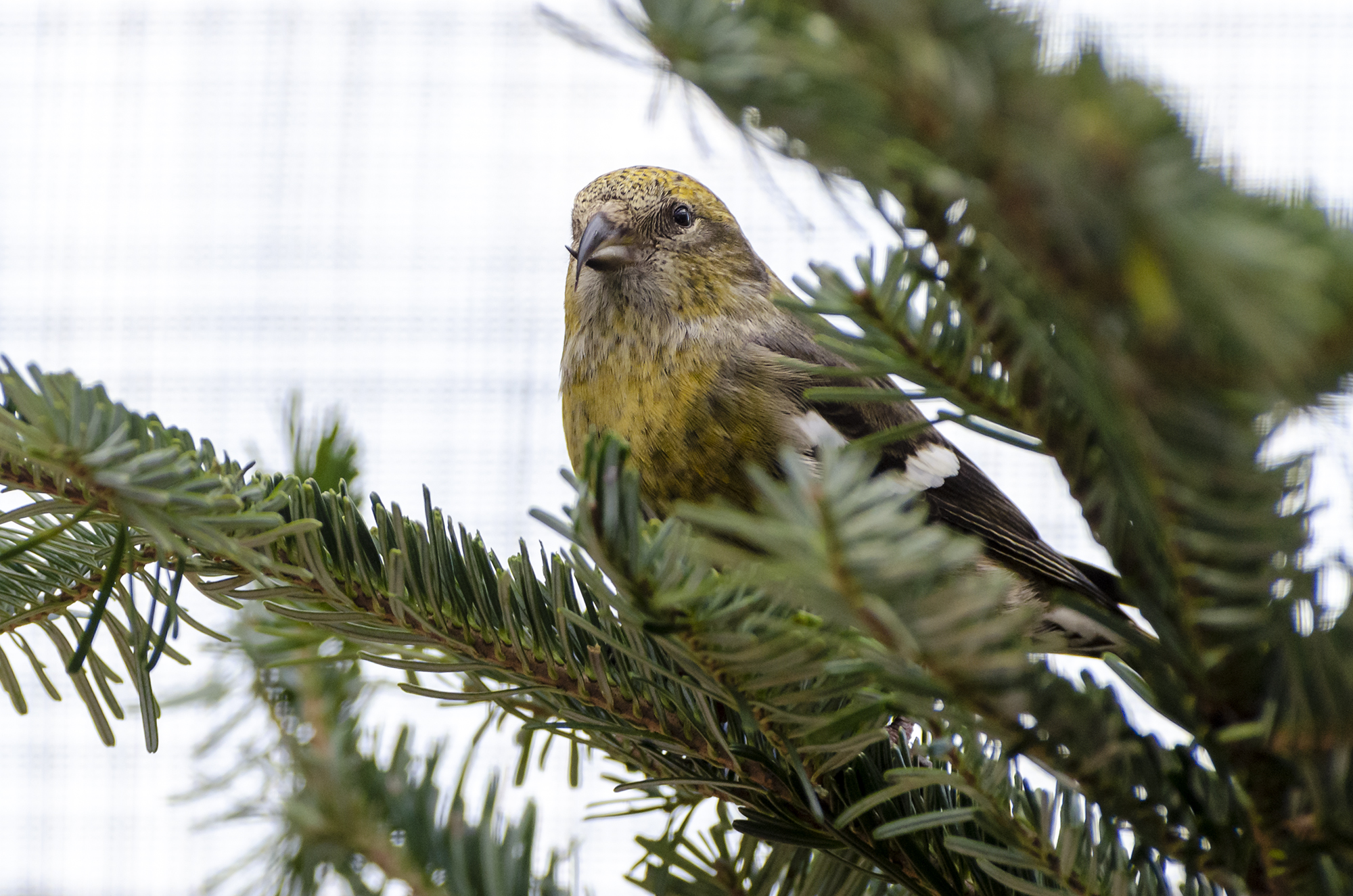
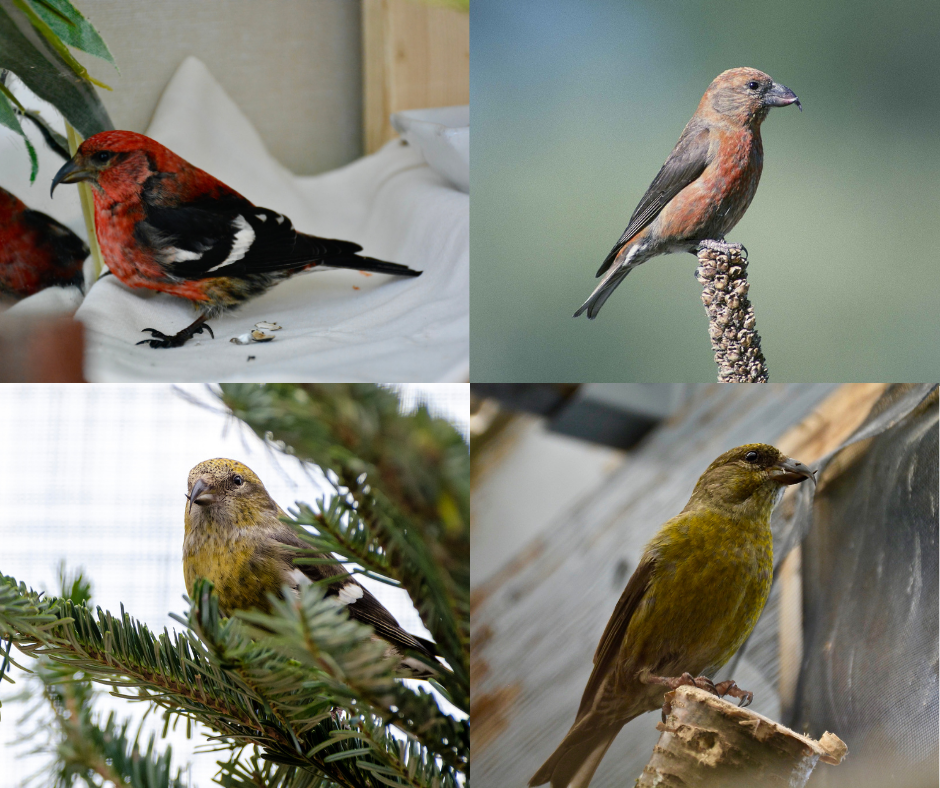
Two crossbill species exist in Alberta; the Red Crossbill (Loxia curvirostra) and White-winged crossbill (Loxia leucoptera). The name of this group of birds spotlights the magic of coevolution. “Crossbill” refers to the literal overlapping tips of their bills specialized to attain conifer seeds.1
Evolution of the Crossbill
Evolution exists in two mechanisms (1) survival and (2) reproduction. In a population of crossbills that live in a coniferous forest, most will have bills that function in the same way. Let’s say that perhaps one or two have a bill that is angled slightly more to the left or the right. These slight differences arise because of gene mutation in an individual bird. Gene mutations can be advantageous (thicker fur in colder climates), neutral (different eye colors), or disadvantageous (diseases, for example). This makes up what we call genetic variation in a given population.
Mechanism #1: Survival
The first step in the evolutionary process is for individuals to survive to adulthood. In crossbills, the shape of the bill may come in handy here. Say one crossbill has a beak that is angled in a way that makes it easy to extract the seeds from the conifer cones. That crossbill is able to stay well fed and grow. Perhaps another crossbill has a differently shaped beak and struggles to access the seeds. This second crossbill might not make it to adulthood.
Mechanism #2: Reproduction
Once a crossbill successfully reaches adulthood, they will reproduce, passing on their advantageous mutation (the shape of their bill) to their offspring. The offspring (with the same bill shape – though inheritance of a trait may not always be guaranteed), will follow the same path to adulthood and reproduce. Despite this, some offspring may still be born with bill shapes that are disadvantageous in survival. Over time, offspring with disadvantageous bill morphology are slowly removed from the population, as they are unable to easily access their food sources and often will not survive.
This mechanism, which may act over millions of years and generations, leads to evolution! Evolution works with what already exists. The genetic variation present in a population and the individuals that are able to pass down advantageous mutations contribute to the morphological changes in crossbills throughout history.
Coevolution
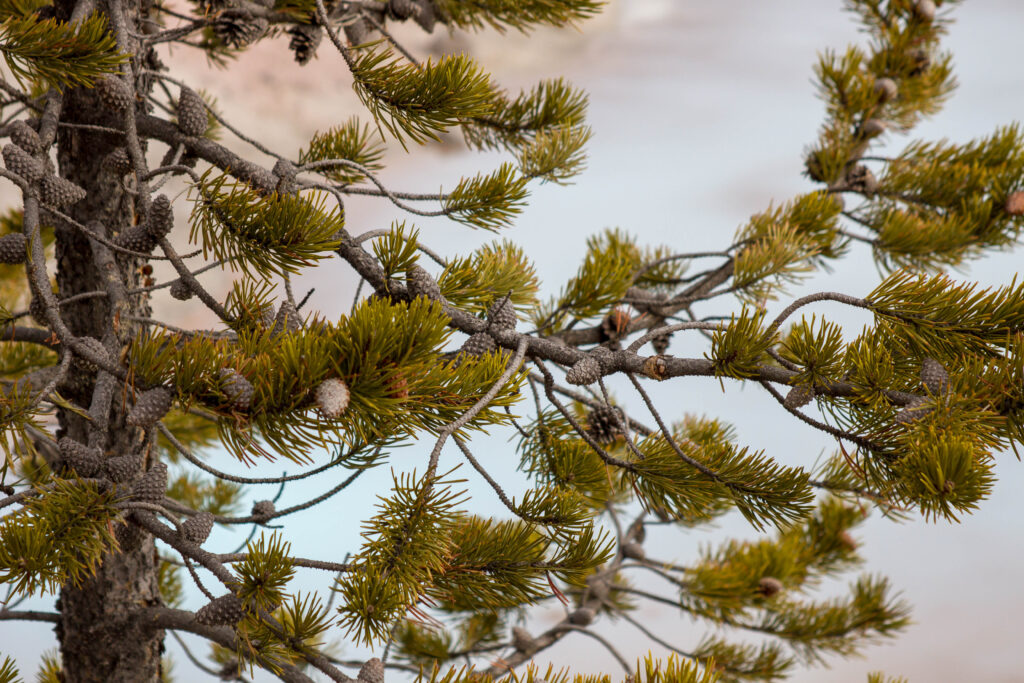
How cool is that! Now, when you see crossbills or conifers out in the wild, you’ll know about this magical relationship happening just before our eyes. Isn’t nature spectacular?
References
- Hack, Benjamin. “Craig Benkman’s 40-Year Fascination With Crossbills and Conifers.” All About Birds. October 1 2025. Craig Benkman’s 40-Year Fascination With Crossbills and Conifers | All About Birds
- Centanni, Caleb., & Young, Matthew. “A Crossbill’s Guide to Conifers in Western North America: A How-to for Finding Crossbills.” Finch Research Network. July 4 2025. A Crossbill’s Guide to Conifers in Western North America: A How-to for Finding Crossbills – FINCH RESEARCH NETWORK
- Benkman, Craig.W. “Diversifying Coevolution between Crossbills and Conifers.” Evo Edu Outreach 3, 47–53 (2010). https://doi.org/10.1007/s12052-009-0190-8