by Holly Hastings
There are a few animals in the wild that portray the intricate relationship between predator and prey so clearly. One of them, as Ruth Kamnitzer explains in Mongabay, is one of the most well-known examples in ecology and will likely be one of the first examples you encounter when opening an ecology textbook: the boom-and-bust cycle of the Canada lynx (Lynx canadensis) and snowshoe hare (Lepus americanus).¹
The boom-and-bust cycle works like this: when snowshoe hare populations are abundant, lynx have access to more food, which improves their reproductive success.² As a result, more lynx kittens survive to adulthood and continue the reproductive cycle.³ This increases lynx population numbers, which then creates an even greater demand for hare populations to sustain them.⁴ But then comes the bust. Every nine to eleven years, snowshoe hare populations can dramatically decline, leaving large lynx populations searching for enough food to survive.⁵
One of the many ways lynx have adapted to declining hare populations is through migration, sometimes “moving hundreds of kilometres from their home ranges” in search of prey.⁶ However, unlike some other animals capable of travelling more than 50 kilometres per day, lynx are not considered long-distance migrants. Instead, they slowly walk across large areas, which continues to baffle ecologists studying their movements.⁷
You might be asking: what causes hare populations to collapse?
Well, that’s the question.
Ecologists have long debated whether these population cycles are driven by bottom-up or top-down forces. The bottom-up theory suggests that prey species, such as hares, regulate the food pyramid by controlling the resources available to predators. The top-down theory suggests that predators, such as lynx, regulate prey populations.⁸ However, recent research suggests that the answer may involve a combination of both factors.⁹ Much like the long-debated “nature versus nurture” discussion, it turns out that ecological systems are often much more complicated than choosing one explanation over another.
One theory explaining snowshoe hare population declines does not actually focus on lynx, but rather on other predators.¹⁰ When hare populations become abundant, predators such as “great horned owls, golden eagles, wolverines and coyotes are capable of ‘prey switching’ and ‘tuning into snowshoe hare’ when they are plentiful.”¹¹ However, once hare populations begin to decline, these predators return to their usual food sources. Lynx, on the other hand, are highly specialized hunters that rely heavily on snowshoe hare and have fewer alternative prey options available.¹²
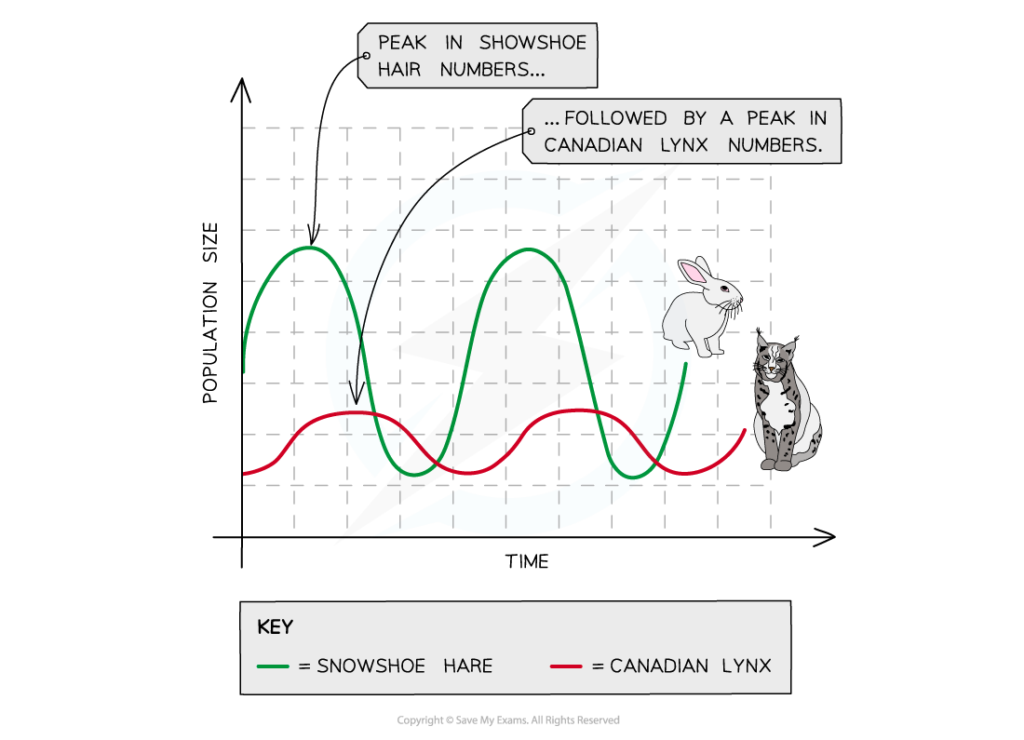
The boom-and-bust cycle of hare and lynx populations has been documented for generations through Indigenous knowledge and “centuries of fur trapping data.” ¹³ Over the last several decades, however, researchers have observed fewer extreme population peaks than historically recorded.¹⁴ The reason for this change is not yet fully understood, but climate change is one possible contributing factor.¹⁵ According to Laurence Fox in Arctic Focus, Yukon is receiving approximately one-third less snow than it historically did.¹⁶ While this may negatively impact lynx, it can benefit one of our most adaptable predators: the coyote (Canis latrans).
A deeply misunderstood yet magnificent animal, the coyote is considered a keystone species, meaning it plays an essential role in maintaining ecosystem balance. I recently completed my master’s thesis on coyote ecology, and I would like to explain a little about how climate change affects the ways coyotes (and other predators, including lynx) interpret changing environmental cues, which can lead to behavioural adaptations.
I promise not to regurgitate my entire thesis here — I will not dive into behavioural adaptations in this article — but if this topic interests you, I encourage you to explore it further!
Wildlife relies on environmental cues, such as temperature and photoperiod (day length), to anticipate seasonal changes.¹⁷ Climate change, particularly earlier springs and delayed winters, along with artificial light at night, can create mismatches between these environmental cues and the behaviours they trigger. These mismatches can affect migration timing, phenology (which is especially relevant here), and reproduction timing — all of which are carefully synchronized so offspring are born when food availability is highest. Isn’t that neat?¹⁸
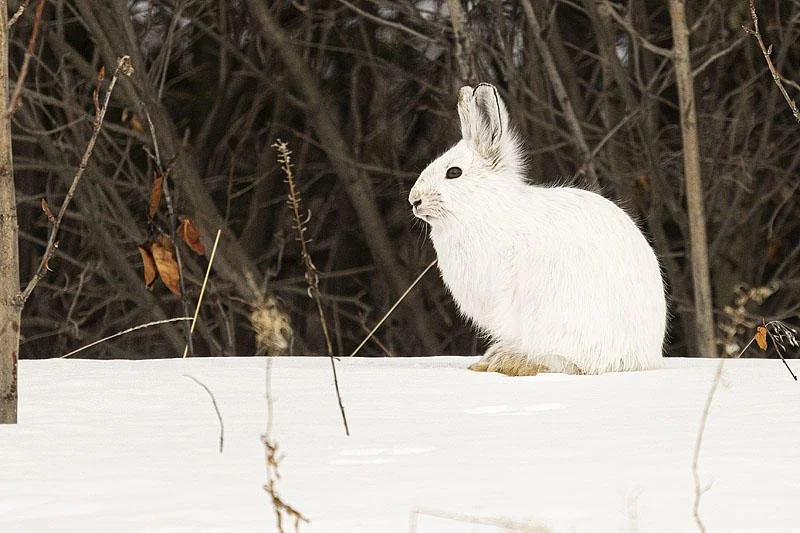
I mentioned phenology above. For example, phenology refers to the timing of seasonal biological events, such as when a hare moults its coat from brown to white (or vice versa) based on environmental cues. Each colour provides important camouflage within its surroundings. However, when climate change causes mismatches — such as shorter winters — hares may not moult at the appropriate time and can become stuck with a bright white coat against a brown landscape, or a brown coat against the snow.¹⁹ This makes them much easier for predators to detect.
However, even if a hare is sporting a brown coat during a snowy winter, it may still have an advantage against coyotes. Snowshoe hares and lynx both have large, furry footpads that are “adapted to float atop deep powder.”²⁰ Coyotes, on the other hand, have smaller footpads that sink into deep snow, meaning snowshoe hares can often outrun them in these conditions.²¹
But don’t worry too much about these sweet little hares, because once the snow has fully melted, they regain the upper hand in speed against both predators!²²
Bibliography
- Kamnitzer, Ruth. “New research sheds light on Canada lynx-snowshoe hare cycle, human impacts.” Mongabay. May 14 2025. https://news.mongabay.com/2025/05/new-research-sheds-light-on-canada-lynx-snowshoe-hare-cycle-human-impacts/
- Fox, Laurence. “Missing lynx: The boom-bust cycle of the snowshoe hare and its dedicated Arctic predator.” Arctic Focus. https://www.arcticfocus.org/stories/missing-lynx-boom-bust-cycle-snowshoe-hare-and-its-dedicated-arctic-predator/
- Fox, Laurence. “Missing lynx: The boom-bust cycle of the snowshoe hare and its dedicated Arctic predator.” Arctic Focus. https://www.arcticfocus.org/stories/missing-lynx-boom-bust-cycle-snowshoe-hare-and-its-dedicated-arctic-predator/
- Fox, Laurence. “Missing lynx: The boom-bust cycle of the snowshoe hare and its dedicated Arctic predator.” Arctic Focus. https://www.arcticfocus.org/stories/missing-lynx-boom-bust-cycle-snowshoe-hare-and-its-dedicated-arctic-predator/
- Fox, Laurence. “Missing lynx: The boom-bust cycle of the snowshoe hare and its dedicated Arctic predator.” Arctic Focus. https://www.arcticfocus.org/stories/missing-lynx-boom-bust-cycle-snowshoe-hare-and-its-dedicated-arctic-predator/
- Fox, Laurence. “Missing lynx: The boom-bust cycle of the snowshoe hare and its dedicated Arctic predator.” Arctic Focus. https://www.arcticfocus.org/stories/missing-lynx-boom-bust-cycle-snowshoe-hare-and-its-dedicated-arctic-predator/
- Fox, Laurence. “Missing lynx: The boom-bust cycle of the snowshoe hare and its dedicated Arctic predator.” Arctic Focus. https://www.arcticfocus.org/stories/missing-lynx-boom-bust-cycle-snowshoe-hare-and-its-dedicated-arctic-predator/
- Fox, Laurence. “Missing lynx: The boom-bust cycle of the snowshoe hare and its dedicated Arctic predator.” Arctic Focus. https://www.arcticfocus.org/stories/missing-lynx-boom-bust-cycle-snowshoe-hare-and-its-dedicated-arctic-predator/
- Fox, Laurence. “Missing lynx: The boom-bust cycle of the snowshoe hare and its dedicated Arctic predator.” Arctic Focus. https://www.arcticfocus.org/stories/missing-lynx-boom-bust-cycle-snowshoe-hare-and-its-dedicated-arctic-predator/
- Fox, Laurence. “Missing lynx: The boom-bust cycle of the snowshoe hare and its dedicated Arctic predator.” Arctic Focus. https://www.arcticfocus.org/stories/missing-lynx-boom-bust-cycle-snowshoe-hare-and-its-dedicated-arctic-predator/
- Fox, Laurence. “Missing lynx: The boom-bust cycle of the snowshoe hare and its dedicated Arctic predator.” Arctic Focus. https://www.arcticfocus.org/stories/missing-lynx-boom-bust-cycle-snowshoe-hare-and-its-dedicated-arctic-predator/
- Fox, Laurence. “Missing lynx: The boom-bust cycle of the snowshoe hare and its dedicated Arctic predator.” Arctic Focus. https://www.arcticfocus.org/stories/missing-lynx-boom-bust-cycle-snowshoe-hare-and-its-dedicated-arctic-predator/
- Kamnitzer, Ruth. “New research sheds light on Canada lynx-snowshoe hare cycle, human impacts.” Mongabay. May 14 2025. https://news.mongabay.com/2025/05/new-research-sheds-light-on-canada-lynx-snowshoe-hare-cycle-human-impacts/
- Fox, Laurence. “Missing lynx: The boom-bust cycle of the snowshoe hare and its dedicated Arctic predator.” Arctic Focus. https://www.arcticfocus.org/stories/missing-lynx-boom-bust-cycle-snowshoe-hare-and-its-dedicated-arctic-predator/
- Fox, Laurence. “Missing lynx: The boom-bust cycle of the snowshoe hare and its dedicated Arctic predator.” Arctic Focus. https://www.arcticfocus.org/stories/missing-lynx-boom-bust-cycle-snowshoe-hare-and-its-dedicated-arctic-predator/
- Fox, Laurence. “Missing lynx: The boom-bust cycle of the snowshoe hare and its dedicated Arctic predator.” Arctic Focus. https://www.arcticfocus.org/stories/missing-lynx-boom-bust-cycle-snowshoe-hare-and-its-dedicated-arctic-predator/
- Walker, William H, Olga Hecmarie Meléndez‐Fernández, Randy J Nelson, and Russel J Reiter. “Global Climate Change and Invariable Photoperiods: A Mismatch That Jeopardizes Animal Fitness.” Ecology and Evolution (Bognor Regis) 9, no. 17 (2019): 10044–54. https://doi.org/10.1002/ece3.5537.
- Walker, William H, Olga Hecmarie Meléndez‐Fernández, Randy J Nelson, and Russel J Reiter. “Global Climate Change and Invariable Photoperiods: A Mismatch That Jeopardizes Animal Fitness.” Ecology and Evolution (Bognor Regis) 9, no. 17 (2019): 10044–54. https://doi.org/10.1002/ece3.5537.
- Kamnitzer, Ruth. “New research sheds light on Canada lynx-snowshoe hare cycle, human impacts.” Mongabay. May 14 2025. https://news.mongabay.com/2025/05/new-research-sheds-light-on-canada-lynx-snowshoe-hare-cycle-human-impacts/
- Kamnitzer, Ruth. “New research sheds light on Canada lynx-snowshoe hare cycle, human impacts.” Mongabay. May 14 2025. https://news.mongabay.com/2025/05/new-research-sheds-light-on-canada-lynx-snowshoe-hare-cycle-human-impacts/
- Kamnitzer, Ruth. “New research sheds light on Canada lynx-snowshoe hare cycle, human impacts.” Mongabay. May 14 2025. https://news.mongabay.com/2025/05/new-research-sheds-light-on-canada-lynx-snowshoe-hare-cycle-human-impacts/
- Kamnitzer, Ruth. “New research sheds light on Canada lynx-snowshoe hare cycle, human impacts.” Mongabay. May 14 2025. https://news.mongabay.com/2025/05/new-research-sheds-light-on-canada-lynx-snowshoe-hare-cycle-human-impacts/