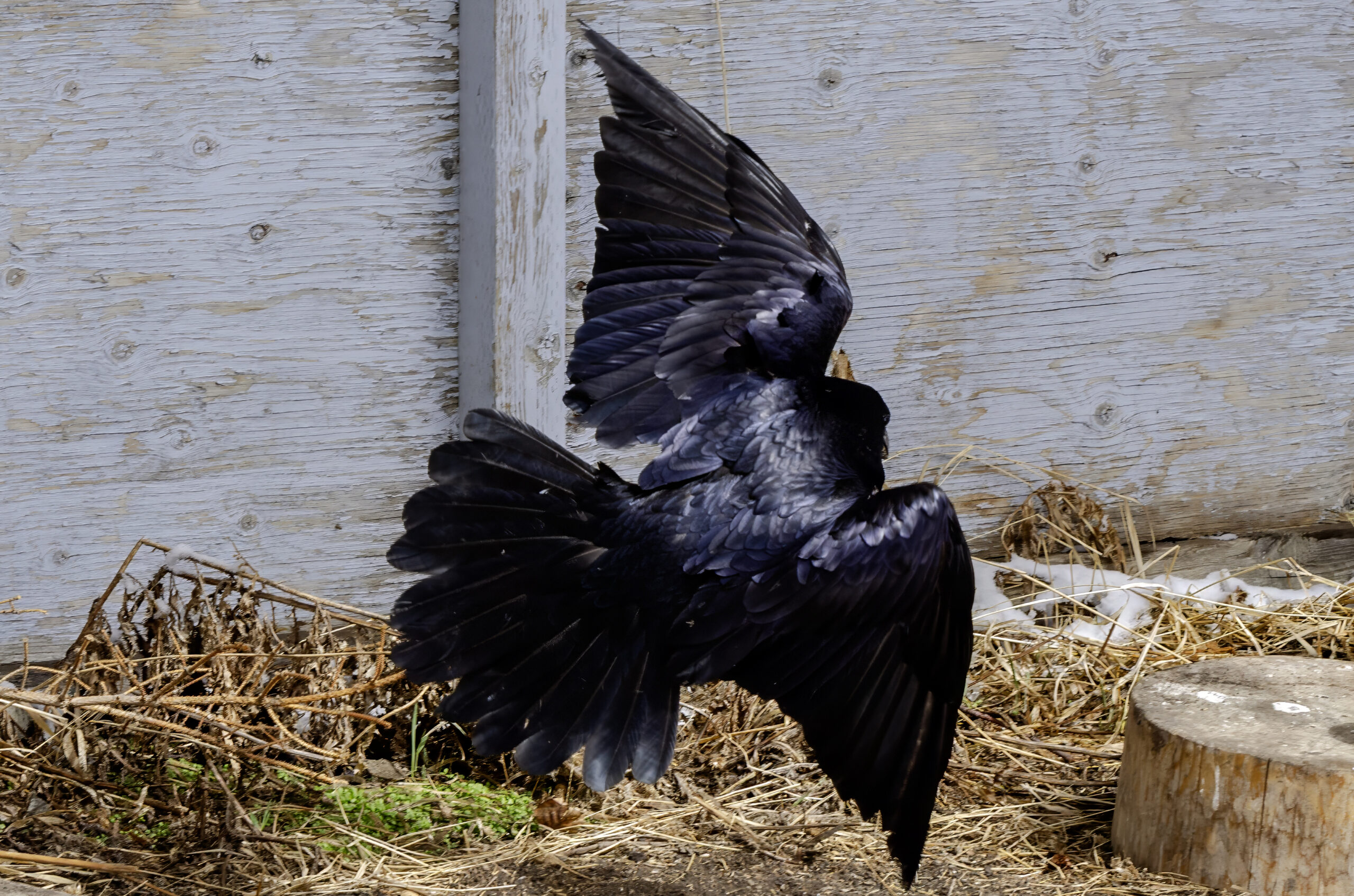
by Jennea Frischke
A couple of summers ago, I had the opportunity to rescue a raven in distress. When I first found them, I wasn’t 100% sure if it was a raven or a crow, and I was shocked that I didn’t know! Based on what I knew at the time, I assumed that because of their large size, shaggy chest feathers, and hefty beak, they were probably a raven.
I then realized that I didn’t know much about the differences between these two often-misunderstood corvids, other than that they were both incredibly smart species. After this interaction with such a majestic bird and learning more about the differences between the two, I found myself playing the “Is it a raven or is it a crow?” game every time I saw a large black bird.
So, what are the similarities and differences between these two birds, and how can you tell them apart? Let’s take a closer look!
What Do Crows and Ravens Have in Common?
The Common Raven (Corvus corax) and the American Crow (Corvus brachyrhynchos) are both large passerine birds belonging to the family Corvidae, which also includes jays and magpies.
Here are a few things they have in common:
Intelligence: Both species are incredibly intelligent and capable of complex problem-solving. They can recognize individual human faces and remember experiences associated with people, which means they may remember both kindness and negative interactions. (3, 4)
Appearance: Both are predominantly black birds with glossy, sometimes iridescent feathers.
Social behaviour: Both species form strong social relationships. Crows and ravens can form long-term pair bonds, and both have complex social lives.
Mysterious reputations: Both birds have a long history of being portrayed as sinister or mysterious symbols in folklore. They even have some rather dramatic collective nouns! A group of crows is famously called a “murder,” while a group of ravens may be called a “conspiracy,” a “treachery,” or an “unkindness.” (5)
Despite these similarities, there are several ways to distinguish between them.
How to Tell a Raven from a Crow
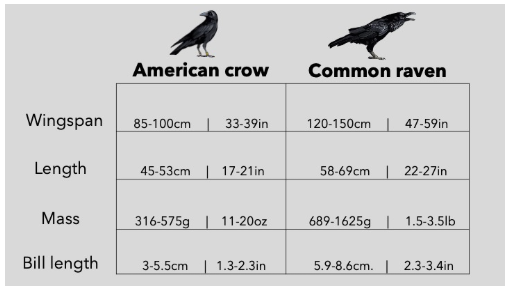
- Size and Beak: Ravens are generally larger than crows, with a heavier build and a much more substantial beak. An adult Common Raven can measure around 27 inches long, while an American Crow is typically around 16–21 inches long. (1, 2). However, size alone isn’t always a reliable indicator. A large crow and a distant raven can be surprisingly difficult to distinguish, so it’s best to look for a few different clues.
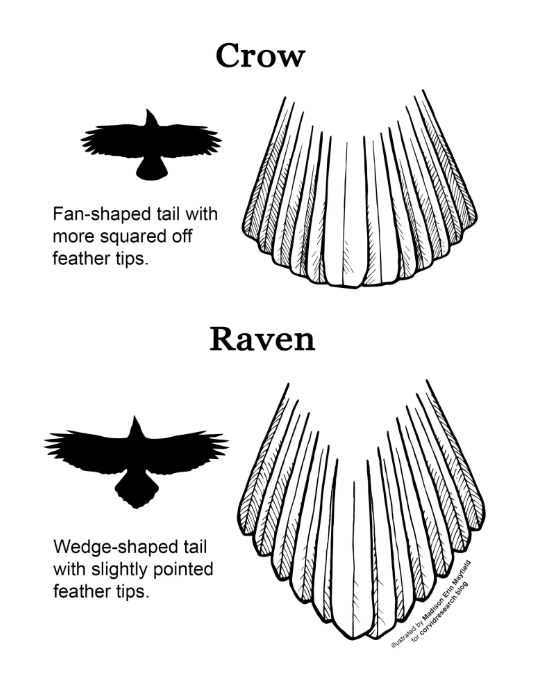
- Tail Feathers: This is one of the easiest visual indicators to spot when a bird is flying! Ravens have wedge-shaped tails, which create a diamond-like appearance in flight. Crows have shorter, more rounded or squared-off tails. If you’re lucky enough to see a large black bird flying overhead, take a moment to look at the shape of its tail. It might help you solve the mystery!
- Wings: Ravens have longer, narrower wings, with more elongated feathers at the wingtips. Crows have relatively broader, more rounded wings, with a more spread-out appearance at the tips. Ravens also tend to have a more graceful, soaring flight, while crows often fly with more regular, rowing-like wingbeats. (1, 2)
- Chest Feathers: Take a closer look at the feathers around the bird’s neck! Ravens have distinctive shaggy throat feathers called hackles. These feathers give the neck a thicker, rougher appearance, especially when raised. Crows generally have a smoother-looking throat and neck.
- Colouring: Both of these majestic black birds have glossy feathers that can show an iridescent sheen in the right light. Depending on the lighting, their feathers may reflect shades of blue, green, or purple. Although ravens can appear particularly glossy, colour alone isn’t a reliable way to tell the two apart.
- Behaviour and Location: Where you see the bird and what it’s doing can also provide useful clues. Crows are commonly seen in urban areas and often gather in groups. They may forage together, communicate with one another, and gather in large numbers at communal roosts. Ravens are often seen alone or in pairs, although they can also gather in groups, particularly around food sources. Younger ravens may spend time in groups before forming their own pair bonds. Here in Calgary, both species can be spotted within city limits. While crows are common in urban areas, ravens also thrive in and around the city, especially given Calgary’s proximity to the Rocky Mountains and its many natural spaces. Ravens are also known for their aerial gymnastics! They may soar, roll, and perform impressive manoeuvres in flight. If you see a large black bird showing off its flying skills, it’s worth taking a closer look. Aerial gymnastics = a good reason to suspect a raven!
- Sound: If you can hear the bird, its call may be one of your best clues. American Crows are known for their familiar, sharp “caw-caw” calls, while Common Ravens often make deeper, rougher, croaking or gurgling sounds. Both species have a wide range of vocalizations, so not every call will fit this simple comparison. (6)
Is It a Raven or a Crow? A Quick Checklist
Still not sure? Here’s a quick cheat sheet to help you decide!
- What shape is the tail? A wedge-shaped tail suggests a raven, while a rounded or squared-off tail suggests a crow.
- How big is the bird? Ravens are generally larger, with a heavier beak, but don’t rely on size alone.
- What do the neck feathers look like? Shaggy throat feathers, or hackles, suggest a raven. Smoother suggests a crow.
- How is it flying? Ravens often soar and glide, while crows tend to use more regular wingbeats.
- What does it sound like? A familiar, sharp caw is typical of a crow, while a deeper croak is characteristic of a raven.
- Is it alone or in a group? Large groups are commonly associated with crows, while ravens are often seen alone or in pairs. However, both species can gather in groups.
When in doubt, look for a combination of clues rather than relying on just one!
My Experience Rescuing a Raven
Now that we’ve covered how to tell these two birds apart, I’d like to share the experience of rescuing the raven that inspired this article.
I had been out running errands for less than an hour, so I was surprised to return home to a cacophony of bird sounds.
My spouse, Derek, had heard the commotion and gone outside to investigate. We quickly realized that a large black bird was crouching on the ground, trying to hide from the birds attacking them. I slowly approached, speaking calmly to avoid frightening them further, while chasing the other birds away. It was clear they couldn’t fly and were favouring one wing.
With it already past 8 p.m. and the AIWC hotline and clinic closed for the evening, we needed somewhere safe to keep the bird overnight. While Derek stood guard against the magpies, I raced downstairs to my vintage clothing studio and grabbed the biggest tub I could find, frantically dumping its contents onto the floor.
The bird was even larger than I’d realized and wouldn’t fit with the lid on, so Derek carried the tub with a blanket draped over the top. We settled them into our basement bathroom, figuring a quiet, dark space would be the safest option until we could get help the next morning. Besides, I’d been meaning to deep-clean that bathroom anyway!
The bird wasn’t particularly interested in staying in the tub, even under the blanket. I was feeling rather hyper from the whole bizarre situation and realized my energy probably wasn’t helping. Derek, who was much calmer than I was, took over, covering the surfaces with towels as the bird hopped around.
Something else seemed unusual: the bird appeared a little disoriented and wasn’t scared of either of us. Although the experience felt almost magical, I knew this wasn’t typical behaviour for a wild bird around strangers. I suspected a possible brain injury, which later proved to be a concern.
We kept the room dark and quiet, left a dish of water nearby, and avoided trying to feed the bird ourselves. Our cat was also very aware that something strange was happening, spending much of the night staring at the bathroom door and pacing around the stairs. Between the bird hopping around and the cat keeping watch, I don’t think any of us got much sleep!
Early the next morning, I called AIWC’s hotline and spoke with a kind, reassuring volunteer. She told me we’d done our best under the circumstances and even laughed when I explained that the bird wouldn’t stay in the covered tub. Apparently, this was an unusual and slightly silly case, even for wildlife rescue!
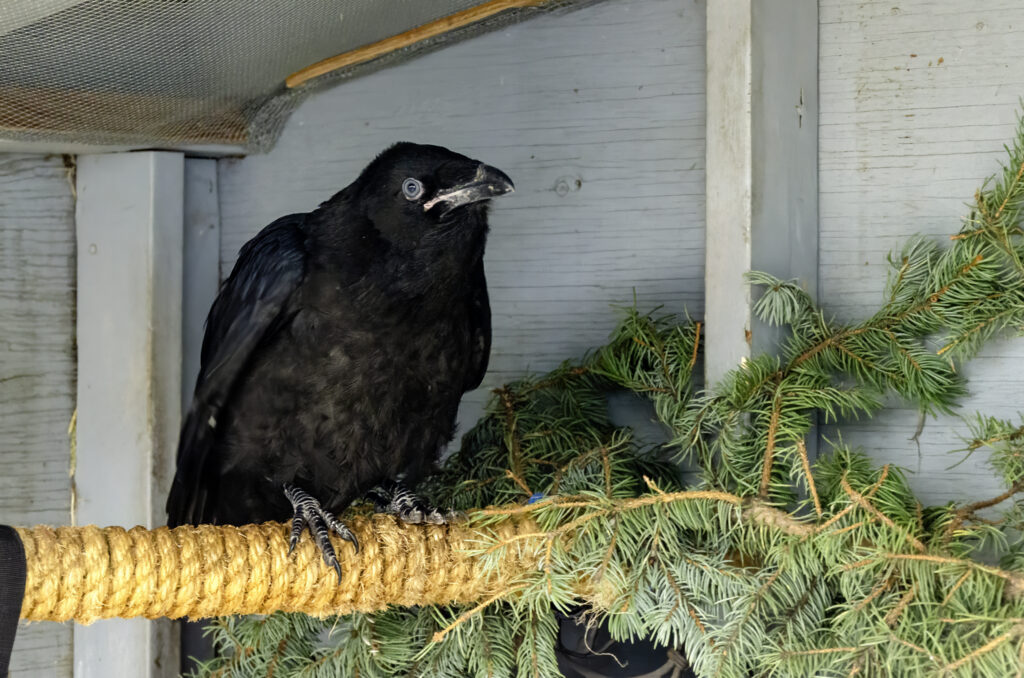
We made the beautiful drive out to AIWC with Derek holding the covered tub in the back seat to keep it from sliding around. The clinic determined that the bird was a juvenile, and further examination and X-rays revealed a suspected brain injury and a fractured wing.
At first, the raven seemed relatively stable, and I hoped they might pull through. I even started making plans in my head to help raise funds for their care. Unfortunately, after five days in care, the raven succumbed to their injuries.
I was heartbroken that the bird didn’t make it, but relieved that we’d been able to get them help and give them a chance to receive care in a safe environment. The experience was both magical and humbling, and the staff and volunteers at AIWC were incredibly kind and supportive throughout the process.
A Final Thought
My experience with this raven taught me more than just how to distinguish between a crow and a raven. It reminded me how easy it is to overlook the details of the wildlife we see every day, and how much there is still to learn about the animals we share our world with.
Both crows and ravens are fascinating, intelligent birds that deserve our appreciation and respect. The next time you spot a large black bird, take a moment to look a little closer. You might discover something new!
And if you ever find a wild bird that appears injured or unable to fly, contact a wildlife rehabilitator for guidance. Only contain the bird if you can do so safely and follow the rehabilitator’s instructions, and avoid offering food or water unless directed by a wildlife professional.
Sometimes, even when a rescue doesn’t have the outcome we hope for, giving an animal the chance to receive care is meaningful in itself.
Bibliography
“Crow vs. Raven.” Nature Mapping Foundation. Accessed October 8, 2026. http://naturemappingfoundation.org/natmap/facts/crow_vs_raven.html.
“13 Surprising and Spooky Raven Facts.” Chirp for Birds. Accessed October 8, 2026. https://chirpforbirds.com/bird-brain/13-surprising-and-spooky-raven-facts/.
“10 Fun Facts About American Crows.” Audubon. Accessed October 8, 2026. https://www.audubon.org/news/10-fun-facts-about-american-crow.
“Raven Behavior.” Corvid Research. Accessed October 8, 2026. https://corvidresearch.blog/category/raven-behavior/.
“Collective Nouns for Birds.” Country Life. Accessed October 8, 2026. https://www.countrylife.co.uk/nature/collective-nouns-for-birds-68344.