by Courtney Collins
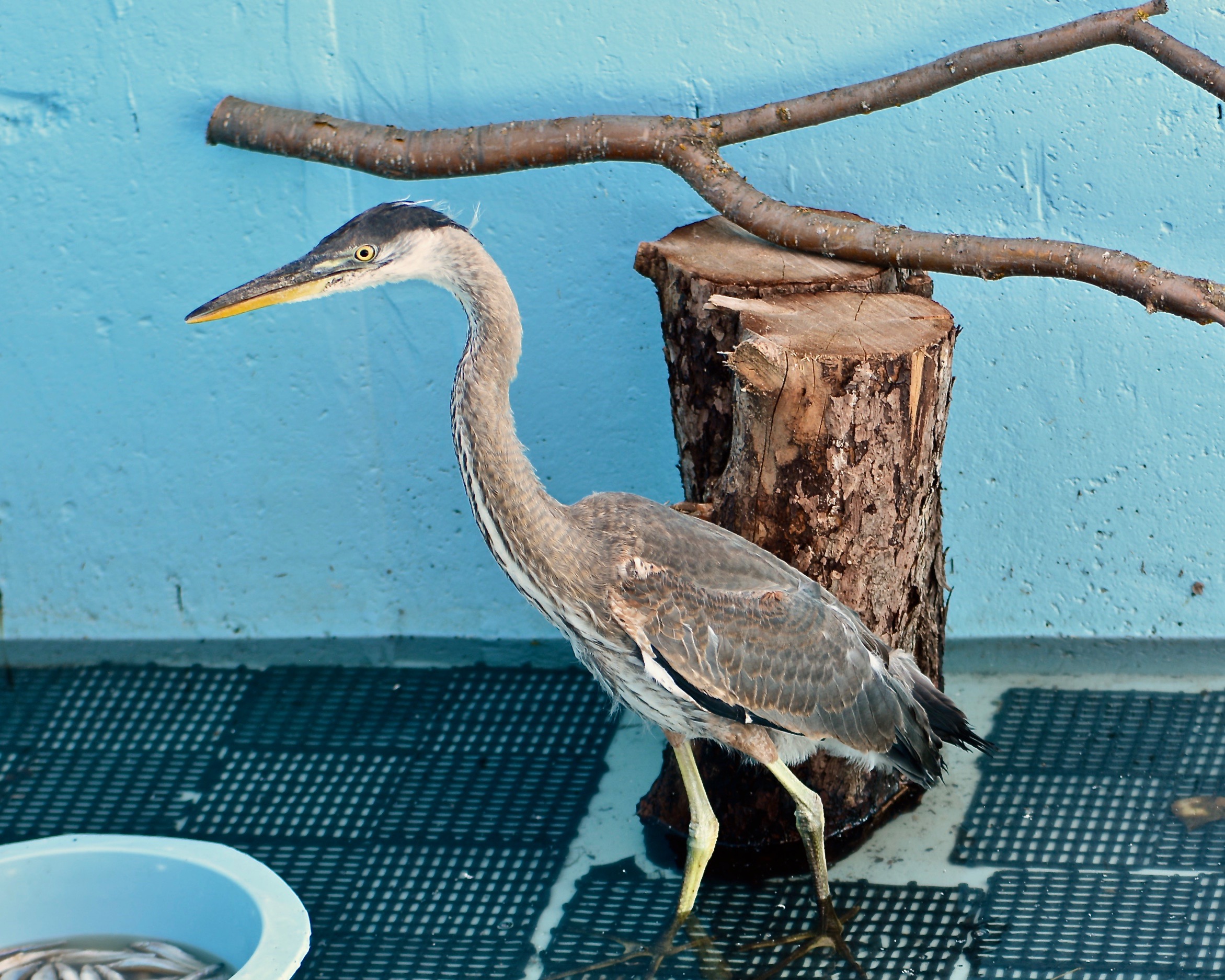
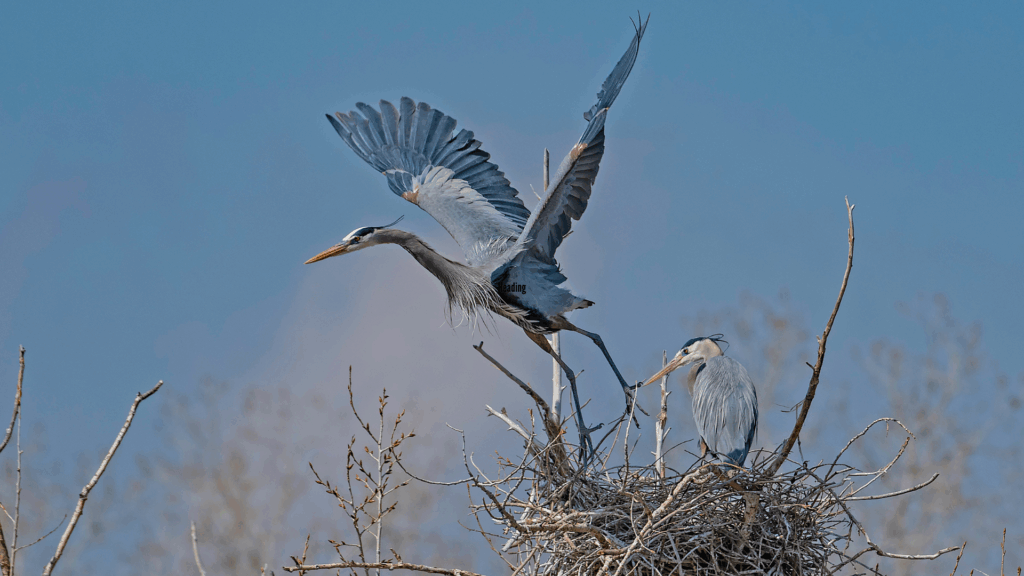
Great blue herons, Ardea herodias, are the largest heron in Canada and the largest wading birds in North America.1 They have blue-grey colouring with a thick black stripe over their eye, a white crown, a long neck, and a yellow-orange beak.2 Adult herons can be stand over 1 meter (~3 feet) in height3 and in flight, their necks form an S-shape, while their legs extend beyond their relatively short tail feathers.4
These herons can be found in shallow fresh or saltwater including ponds, marshes, riverbanks, and shorelines.5 You may almost miss spotting these regal birds because they stand motionless in the water, waiting for prey.6 Each year, they migrate into Alberta in March-April for breeding season and fly south to overwinter in the southern US, Mexico, and the Caribbean in October-November.7 During breeding, herons mainly nest in trees but may also nest elsewhere deemed suitable (including human-made nest platforms8). These amazing birds often nest in colonies (also known as ‘heronries’9 ) of 500+ nests and have elaborate courtship rituals.10 A single tree, outside of Taber, Alberta, was noted to have 12 heron nests.11
Since great blue herons are wetlands birds, their diet consists of fish, amphibians, reptiles, other small animals, insects, and other birds.12 Herons stand statue-still or wade slowly, waiting or looking for food. Once they find something to eat, they strike incredibly fast with their strong, sharp bill. Interestingly, they are solitary fishers and can hunt in the day or nighttime due to strong night-visio.13,14
Great blue herons are generally considered to have healthy populations in Canada. However, the Pacific great blue heron sub-species, Ardea herodias fannini, is listed as ‘special concern’. This sub-species is only found in British Columbia, primarily on the coast, where it forages in marshes, tidal mudflats, and kelp forests.15,16 Additionally, this sub-species does not migrate and lives its entire life in BC. Unfortunately, the threats to the Pacific great blue heron include human disturbance and development, agriculture and aquaculture, and industrial development (i.e., logging, utility lines, road construction, forestry).17,18 These impacts cause both habitat loss and disturbance to herons; once herons have been disturbed, they often abandon their nest. The BC Wildlife Act and the Canadian Migratory Birds Convention Act protect this sub-species, along with its nest and eggs, offering some hope that the species may recover to healthy population numbers.19
If you have questions or see wildlife in need of help, please contact AIWC or your nearest wildlife rescue.
Bibliography
- Edmonton & Area Land Trust, “Great Blue Heron”, February 25, 2016, https://www.ealt.ca/blog/heron
- All About Birds, “Great Blue Heron Identification”, Cornell Lab, 2026, https://www.allaboutbirds.org/guide/Great_Blue_Heron/id
- Hinterland Who’s Who, “Great Blue Heron”, Canadian Wildlife Federation, n.d., https://www.hww.ca/wildlife/birds/great-blue-heron/
- All About Birds, “Great Blue Heron Identification”, Cornell Lab, 2026, https://www.allaboutbirds.org/guide/Great_Blue_Heron/id
- All About Birds, “Great Blue Heron”, Cornell Lab, 2026, https://www.allaboutbirds.org/guide/Great_Blue_Heron/overview
- Edmonton & Area Land Trust, “Great Blue Heron”, February 25, 2016, https://www.ealt.ca/blog/heron
- Edmonton & Area Land Trust, “Great Blue Heron”, February 25, 2016, https://www.ealt.ca/blog/heron
- Ducks Unlimited Canada, “Great blue heron”, 2026, https://www.ducks.ca/species/great-blue-heron/
- All About Birds, “Great Blue Heron Identification”, Cornell Lab, 2026, https://www.allaboutbirds.org/guide/Great_Blue_Heron/id
- All About Birds, “Great Blue Heron Life History”, Cornell Lab, 2026, https://www.allaboutbirds.org/guide/Great_Blue_Heron/lifehistory
- Mike Jokinen and Randy Lee, “A Nest Rescue”, Alberta Conservation Association Conservation Magazine, 2011, 13, https://www.ab-conservation.com/downloads/conservation_magazine/aca_conservationmagazine_v16.pdf
- All About Birds, “Great Blue Heron Life History”, Cornell Lab, 2026, https://www.allaboutbirds.org/guide/Great_Blue_Heron/lifehistory
- All About Birds, “Great Blue Heron Life History”, Cornell Lab, 2026, https://www.allaboutbirds.org/guide/Great_Blue_Heron/lifehistory
- All About Birds, “Great Blue Heron”, Cornell Lab, 2026, https://www.allaboutbirds.org/guide/Great_Blue_Heron/overview
- Nature Canada, “Pacific Great Blue Heron”, (n.d.), https://naturecanada.ca/discover-nature/endangered-species/pacific-great-blue-heron/
- Environment and Climate Change Canada, “Management Plan for the Great Blue Heron fannini subspecies (Ardea herodias fannini) in Canada”, (Species at Risk Act Management Plan Series, Environment and Climate Change Canada, Ottawa, 2020), iii + 26 pp, https://ecprccsarstacct.z9.web.core.windows.net/files/SARAFiles/legacy/plans/mp_great_blue_heron_fannini_e_final.pdf
- Nature Canada, “Pacific Great Blue Heron”, (n.d.), https://naturecanada.ca/discover-nature/endangered-species/pacific-great-blue-heron/
- Environment and Climate Change Canada, “Management Plan for the Great Blue Heron fannini subspecies (Ardea herodias fannini) in Canada”, (Species at Risk Act Management Plan Series, Environment and Climate Change Canada, Ottawa, 2020), iii + 26 pp, https://ecprccsarstacct.z9.web.core.windows.net/files/SARAFiles/legacy/plans/mp_great_blue_heron_fannini_e_final.pdf
- Nature Canada, “Pacific Great Blue Heron”, (n.d.), https://naturecanada.ca/discover-nature/endangered-species/pacific-great-blue-heron/